Hebbia is a well-built product. It's backed by Andreessen Horowitz, valued at $700M, and used by firms managing $30 trillion in assets. Its Matrix interface changed how analysts interact with documents at scale. If you're a PE associate screening 200 CIMs or a credit analyst extracting covenants from 500 loan agreements, Hebbia is built for exactly that job and it does it well.
But "built for one job" and "right for your organization" are different questions. This piece is a comparison from our point of view at StackAI, we'll be upfront about where Hebbia is strong, then walk through where we think the product runs into limits.
Where Hebbia Is Strong
The Matrix interface. Instead of chatting with documents one at a time, Matrix presents AI as a spreadsheet, rows are documents, columns are prompts. An analyst can ask "Extract the EBITDA definition" across 500 credit agreements simultaneously and see every answer in a structured grid. It's a genuinely different interaction model for batch analysis.
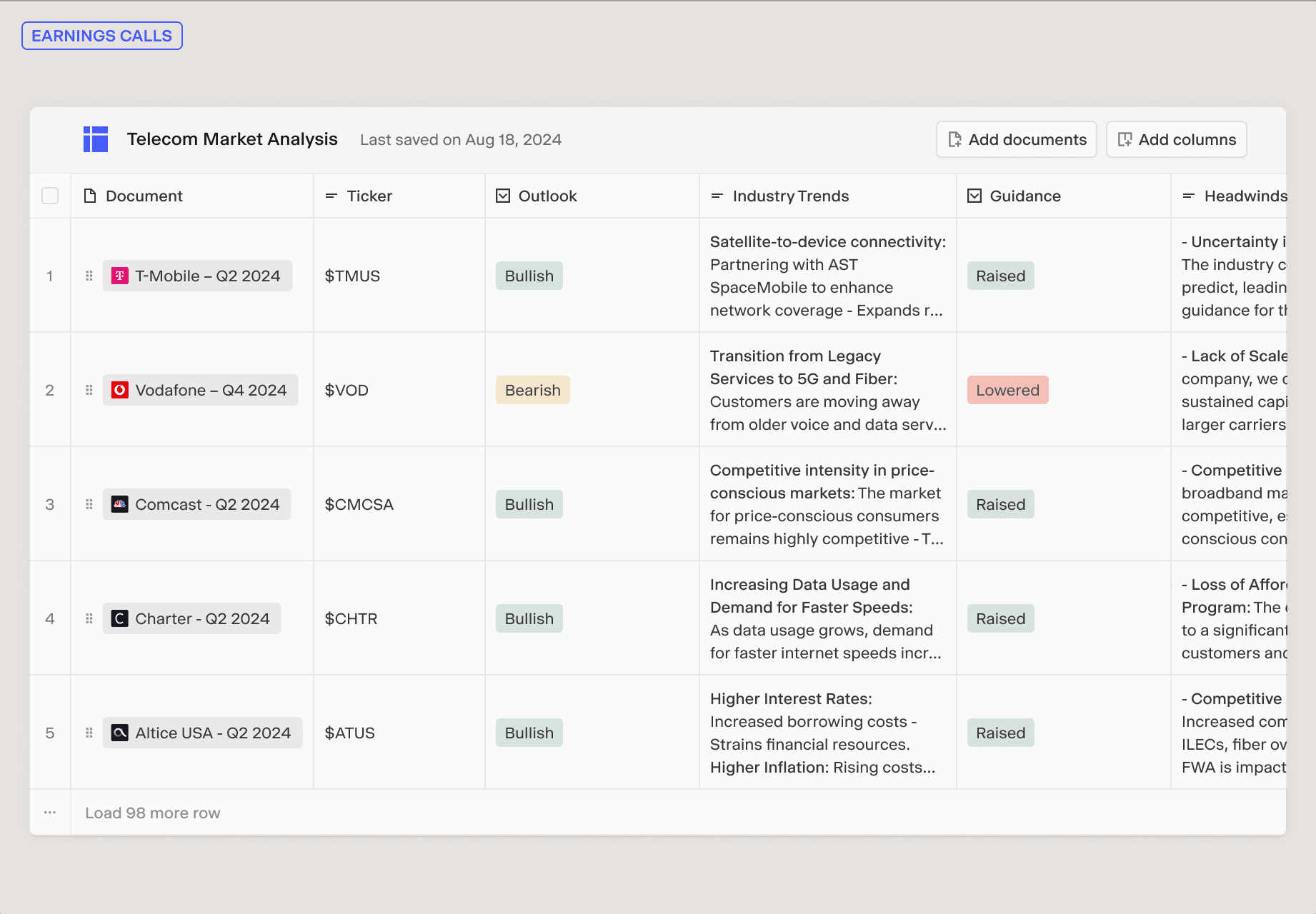
Verifiable citations. Every cell in a Matrix links to the exact passage in the source document. For regulated work where a missed clause has real consequences, that citation architecture matters. OHA reported 6x ROI and 75% faster review times on credit agreements.
Financial data integrations. Hebbia connects natively to FactSet, S&P Capital IQ, PitchBook, Preqin, Third Bridge, and Guidepoint. For PE, credit, and IB workflows, that integration depth is hard to replicate.
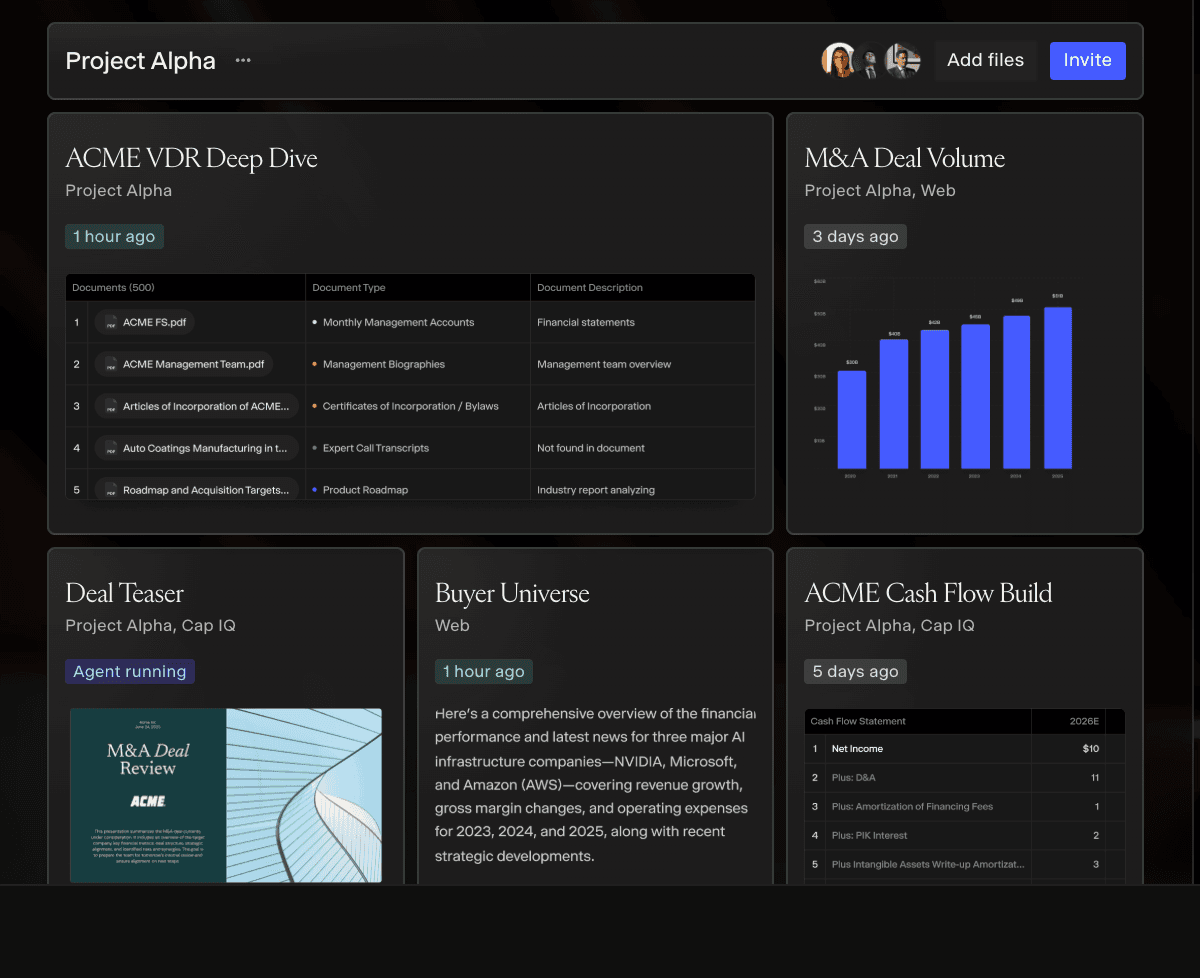
Projects. Hebbia's latest major product release is Projects. This includes always-on background agents (in beta) that monitor for new documents and market signals, a real-time activity feed so anyone joining mid-deal has full context, and the ability to generate client-ready deliverables directly from accumulated analysis. It's a meaningful step from individual analyst productivity toward team-level coordination.
These were category-defining strengths in 2023 and 2024. The question is whether they still are.
Where the Limits Show Up
Hebbia's strengths are real, but they're also narrow. The product was designed to solve one problem well, and it does. The limits only become visible when organizations start asking what comes next: more teams, more workflows, more accountability, and more ownership of what gets built. That's where the gap between a vertical tool and a platform starts to matter.
1. One team becomes many, and the platform compounds.
Hebbia is built for finance. That's a deliberate choice, and it works well for the team that buys it. The problem is what happens next.
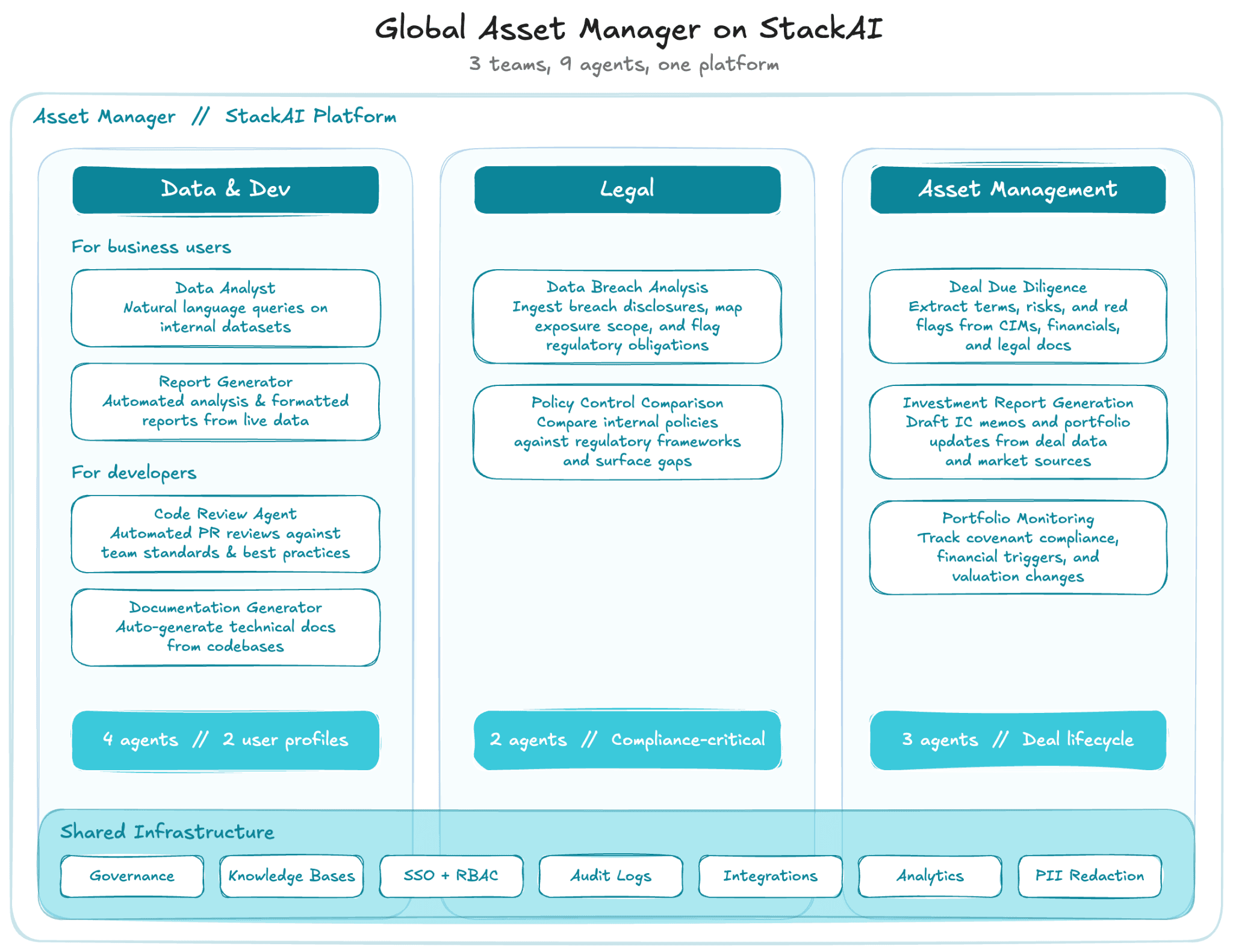
Many of StackAI financial customers started exactly where Hebbia plays, investment teams using AI to analyze deals, screen documents, and research positions.
But once those teams saw the value, adjacent teams wanted in: back-office operations, compliance, HR, legal. Those teams have different workflows entirely, they don't need a document grid, they need agents that process claims, route approvals, answer employee questions, and write back to the systems they already use.
On a single-tool platform, each new team means a new vendor, a new security review, and knowledge that stays siloed. On StackAI, the second deployment costs a fraction of the first, the infrastructure, governance, and integrations are already there, and what finance built can directly inform what ops or legal builds next. The investment compounds.
2. Analysis alone was enough in 2024. It isn't now.
Two years ago, "extract information from documents and cite sources" was a genuine moat. Today the floor and ceiling have both shifted. For ad-hoc Q&A, analysts increasingly drop documents into Claude or Perplexity and get cited answers in seconds, making a $10K/seat specialized tool hard to justify outside true batch workloads.
At the other end, enterprises now want AI that doesn't just read and summarize, but decides, acts, and routes. That requires a fundamentally different product surface: conditional logic, approval gates, system writes, and the ability to plug into wherever work actually happens.
StackAI is built for this. The StackAI Terminal gives the AI Agent an actual sandbox to perform complex document analysis, write code or generate precise visuals. The Code Node allows deterministic logic to run inside any workflow. Interfaces can be tailored, chat, form, Slack bot, widgets embedded in your website, depending on who the end user is. And with 100+ integrations covering Salesforce, Workday, SAP, ServiceNow, Snowflake, Slack, and more, the agent doesn't just produce an output, it streamlines or supercharges the process.
3. Governance isn't an afterthought, it's the foundation.
Hebbia meets baseline compliance requirements: SOC 2, ISO, GDPR. But governance capabilities are more limited.
StackAI was built governance-first. The platform includes eight layers of controls, RBAC, SSO, PII redaction, audit logs, data residency options, and on-premise deployment in the customer's own AWS or Azure environment.
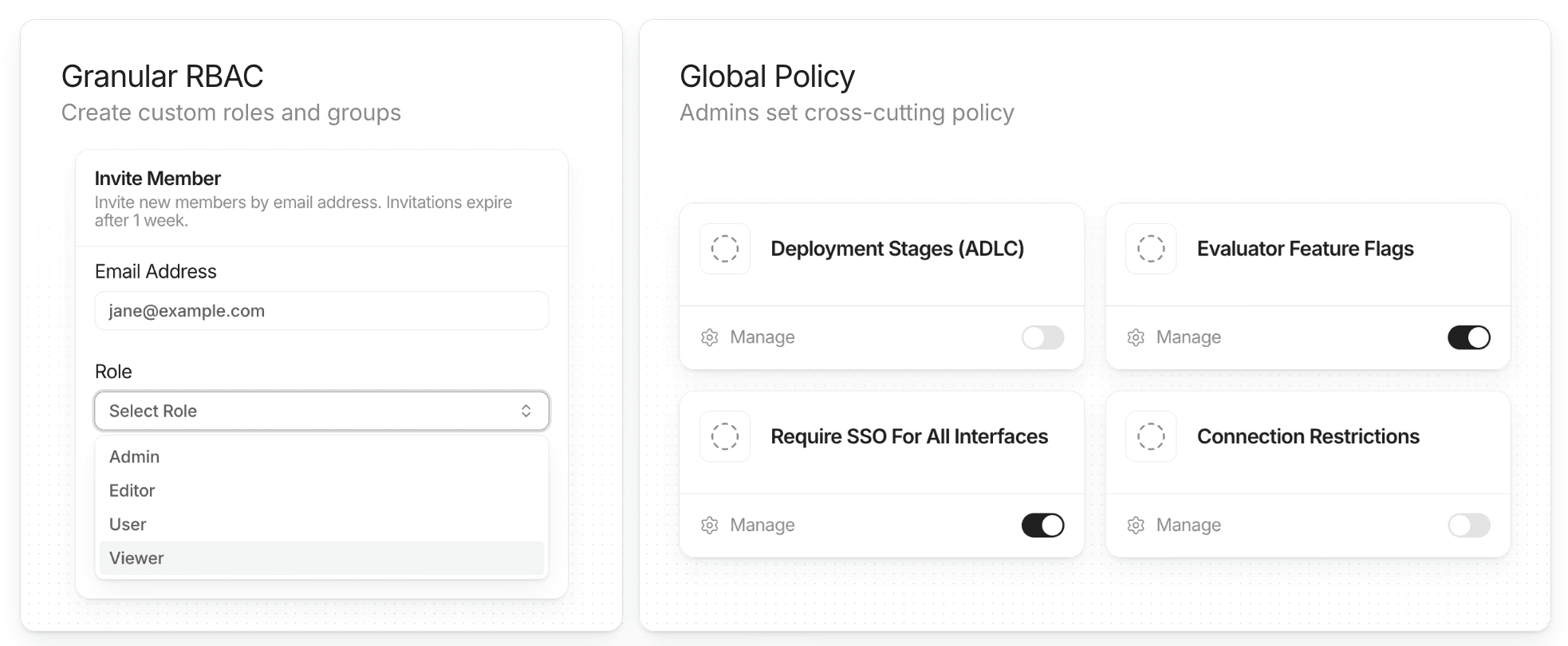
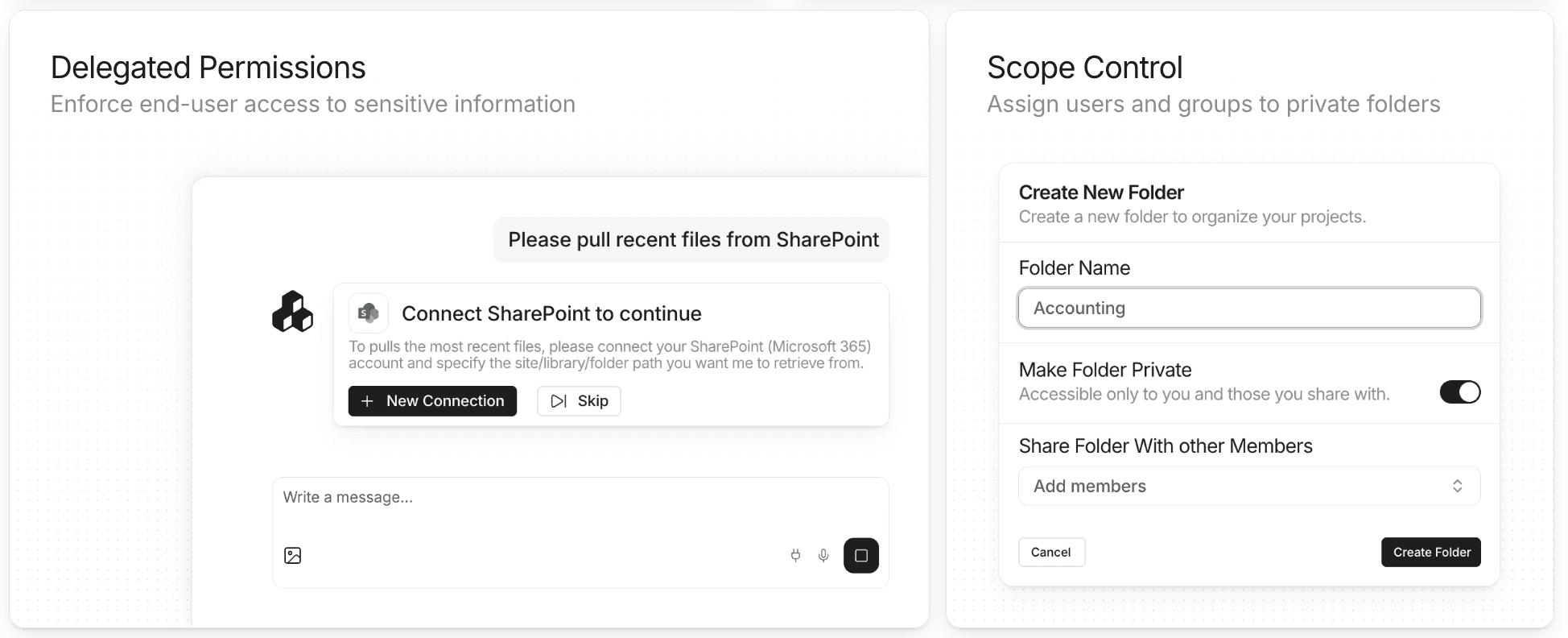
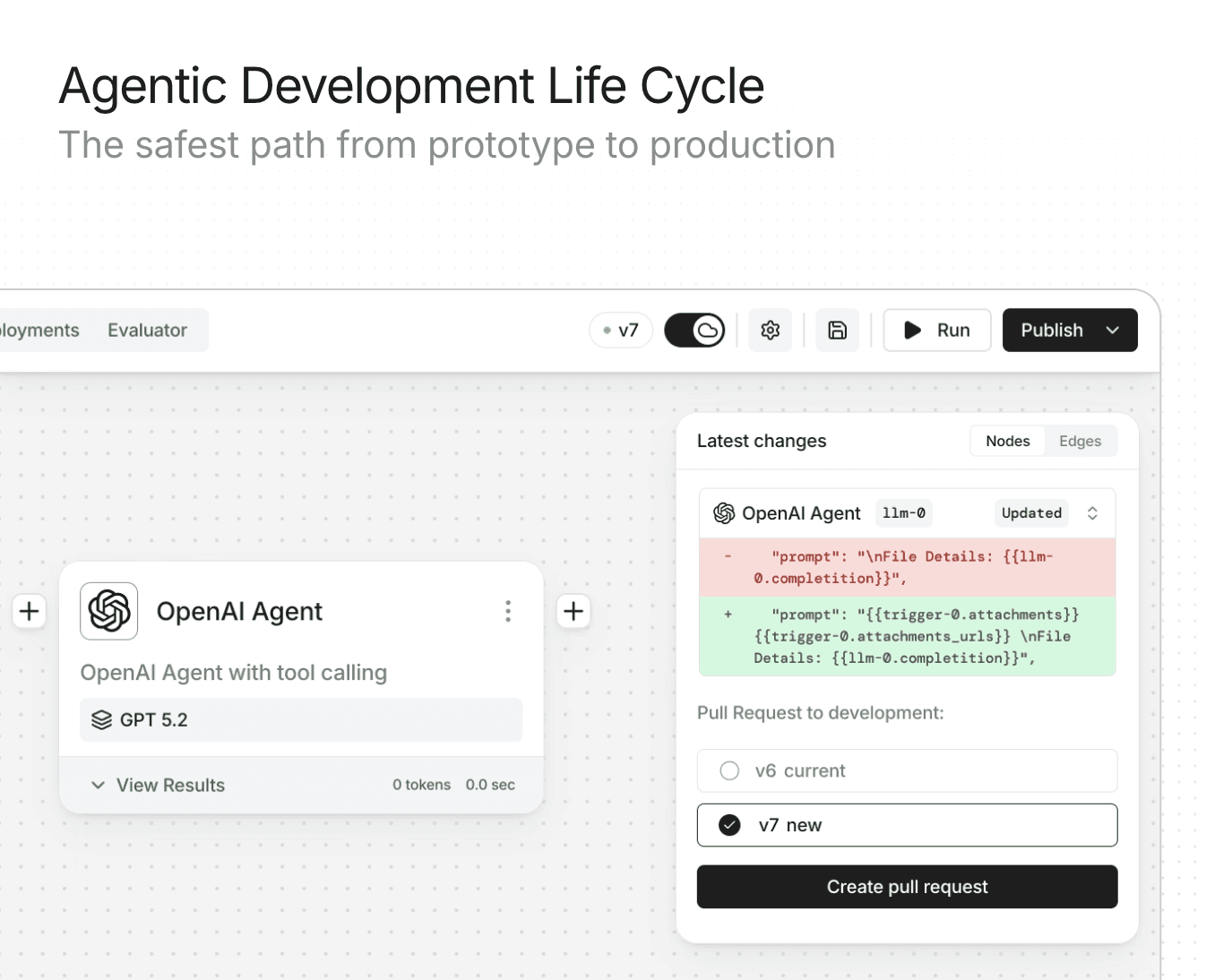
Beyond access control, StackAI gives teams full Software Development Lifecycle tooling for agents: versioning, staging environments, rollback, and approval workflows before any agent change goes to production.
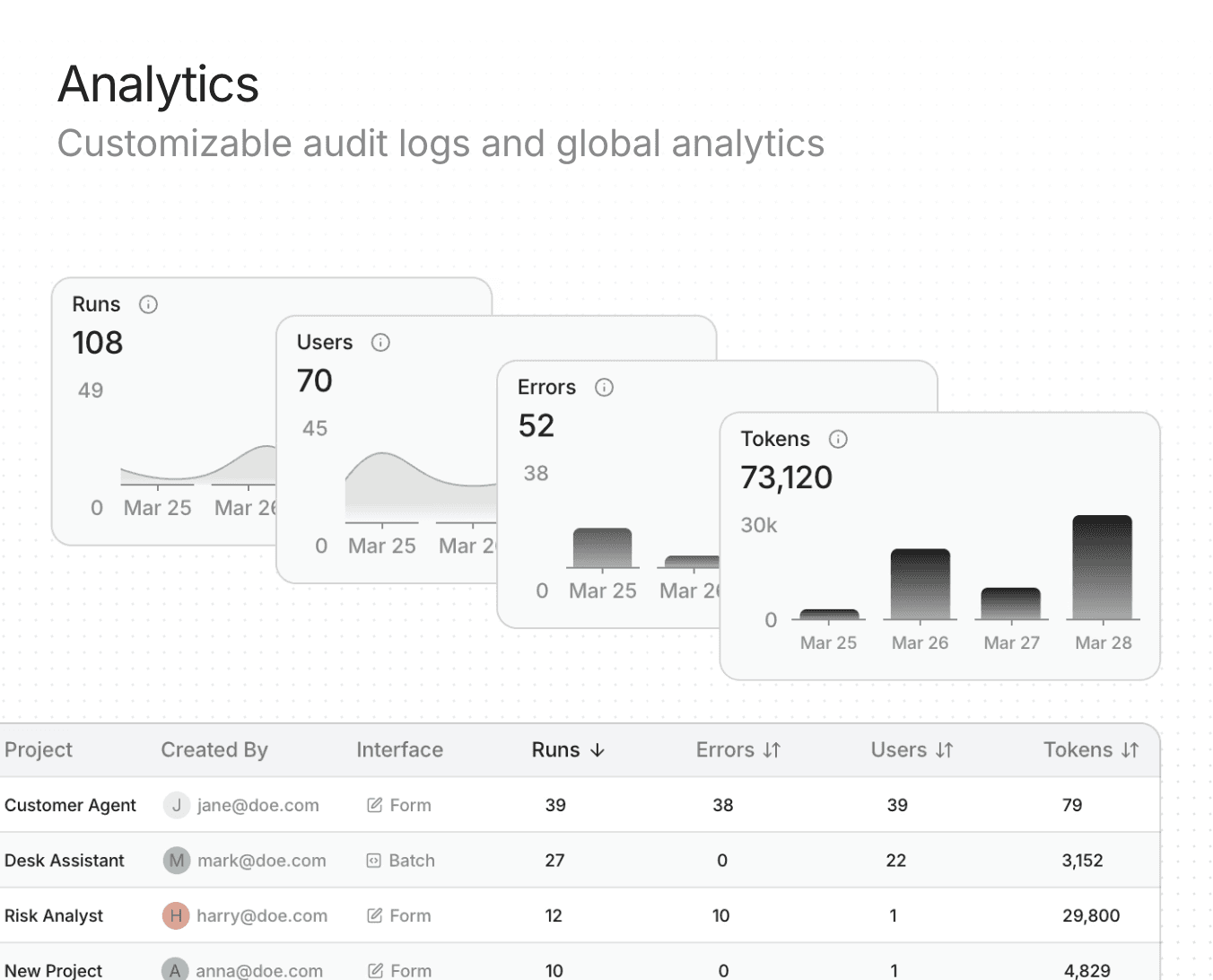
Finally, the analytics layer is built for enterprise accountability, teams can see exactly which agents are being used, by whom, how often, where they're succeeding, and where they're failing. That's the difference between deploying AI and running AI responsibly at scale.
4. Who builds the agents matters.
Hebbia's model is forward-deployed: a team of ex-bankers configures the product for you. That's a strength for getting a finance team up and running on document analysis quickly, but it also means you're dependent on Hebbia's team for every new workflow, every change. The organization never really owns the build.
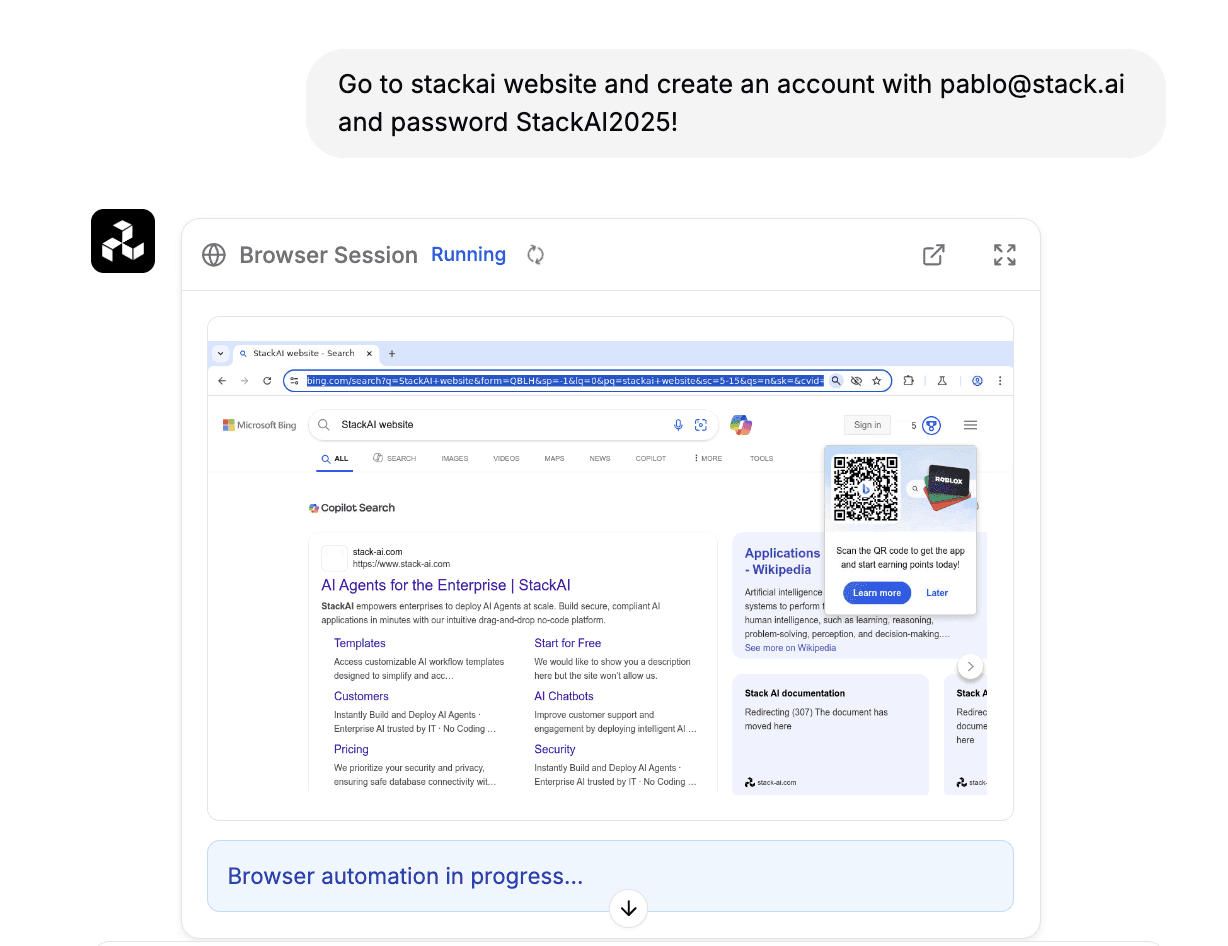
StackAI's model is different. We have a forward-deployed team too, but the goal is to be your partners in the agent deployment journey. StackAI builds with the customer and enables users as builders. Teams who can design, test, and ship new agents themselves. The no-code workflow builder is genuinely accessible to non-developers.
Companies that invest in building internal AI capability on StackAI get compounding returns: each new agent gets faster to build, each new team cheaper to onboard, and the organization accumulates AI expertise that stays when the vendor relationship ends.
TL;DR Comparison
Dimension | Hebbia | StackAI |
Core job | Financial document analysis (Matrix grid + Chat) | Enterprise AI agents that read, decide, act, and route |
Industry & scope | Finance, legal, consulting, single-team focus | Multi-department: finance, insurance, healthcare, government, defense, education, industrials |
AI models | OpenAI-first; Claude available but secondary | LLM-agnostic: OpenAI, Anthropic, Google, Meta, Mistral, open-source, self-hosted |
Workflow & automation | Research and analysis focused | Research and analysis is one piece of hundreds of StackAI workflows — but only a portion of the possibilities |
Integrations | Financial data providers + file storage | 100+ across Salesforce, Workday, SAP, ServiceNow, Snowflake, Slack, Jira, HubSpot, Gmail |
Security & compliance | SOC 2, ISO, GDPR | SOC 2, GDPR, HIPAA, on-premise (customer's own AWS/Azure), PII redaction |
Deployment model | Forward-deployed team; longer implementation cycle | Forward-deployed team that supports building, while also enabling company builders to accelerate agent deployment with faster build-test-deploy cycles |
Pricing | ~$10K/seat/yr (Professional); no public pricing | Published pricing tiers |
How to Think About the Choice
If your AI footprint will stay confined to financial document analysis for one team, Hebbia is purpose-built for it and Matrix is hard to beat. For ad-hoc document Q&A, general-purpose tools like Claude or Perplexity will increasingly do the job at a fraction of the cost.
If you expect AI to show up across finance, ops, HR, compliance, and customer-facing workflows, and to do work, not just analyze it, the question shifts from "which tool is best for this team" to "what platform will the rest of the organization build on."
Both are real questions. The mistake is picking a tool without knowing which one you're answering.
Ready to learn more about why StackAI is the best overall enterprise AI platform? Book a demo with our team of AI experts.
Sources: Hebbia.com product pages, blog posts (April 2026 Disclosure, March 2026 Disclosure, "Introducing Projects"), and customer stories; Hebbia Financial AI Benchmark (2026); StackAI customer case studies.

Marta Llopis
AI Strategist at StackAI