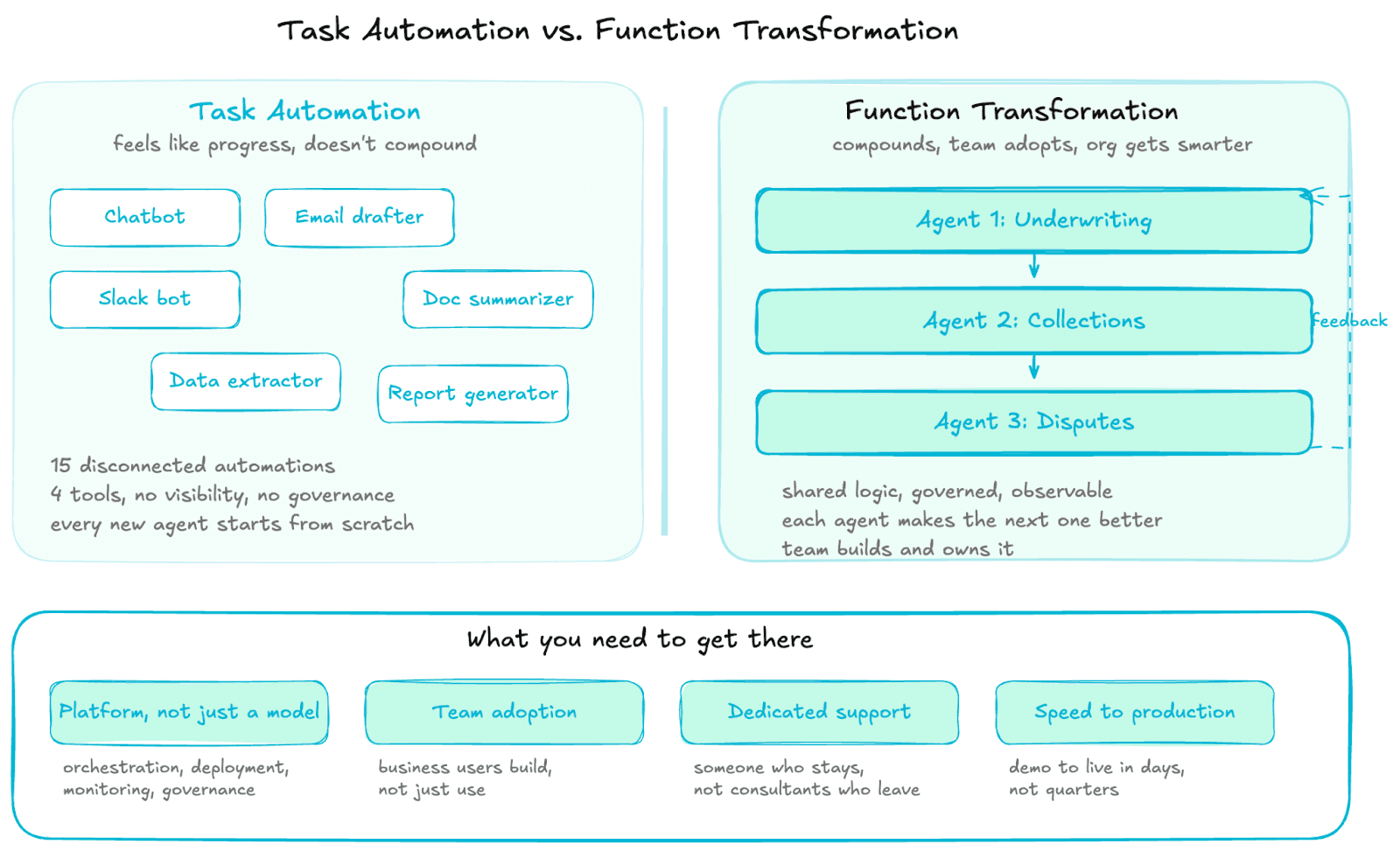
Most BNPL teams use AI in fragments: one workflow here, a copilot there, vertical AI platforms or SaaS everywhere. The result? Isolated gains across silos with no shared data, no feedback loops, no compounding.
The fix: function transformation. Rebuild entire functions on one platform where agents share data, governance, and real-time signals.
According to JM Search, "As institutions and BNPL providers alike work to tighten up lending and credit risk amid the ongoing banking crisis, machine learning and AI are becoming widely used in the industry, with applications ranging from credit assessments, to risk modeling, to fraud detection and more. These technologies have the potential to not only help BNPL more quickly adapt to revenue opportunities, but also keep pace with new regulations and better manage overall risk."
This article applies that approach to three key functions that drive BNPL economics: credit operations, customer support, and merchant operations.
Function 1: Credit Operations
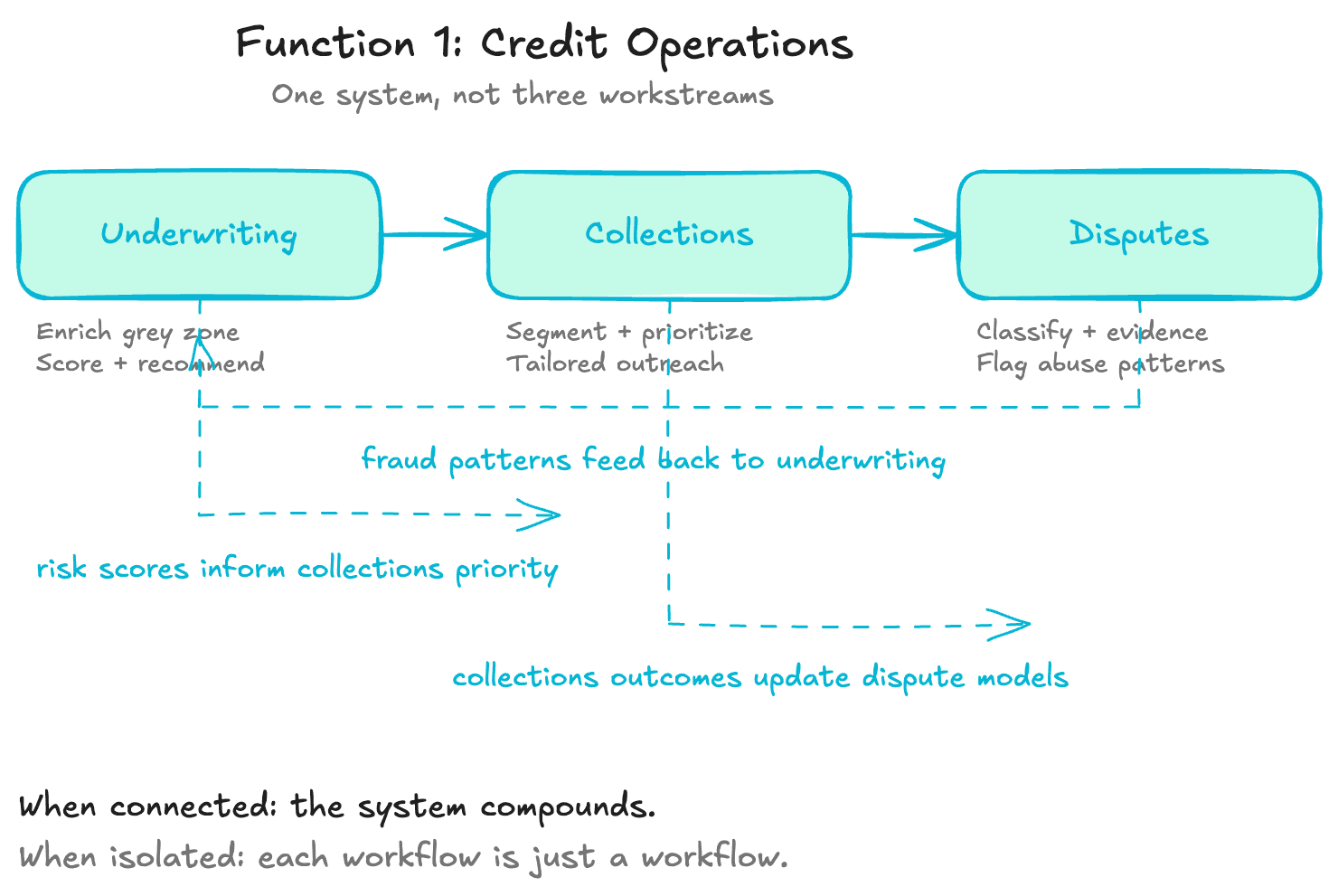
Without transformation: Underwriting, collections, and disputes run separately. No signal sharing. Feedback is manual reports.
With AI transformation: Three agents run on one platform and feed each other.
The Risk Scout agent enriches grey-zone apps with disputes fraud signals; outputs structured reviews.
The Recovery Navigator agent segments delinquents using underwriting scores; drafts compliant outreach.
The Dispute Resolver agent classifies cases, pulls evidence, flags abuse patterns back to underwriting.
Every decision makes the next one smarter.
🔗 Learn More: See the template for an underwriting submission AI agent here and a video of AI agent use cases in insurance here.
Function 2: Customer Support
Without transformation: Support has its own tool and its own data. Agents look up account info manually across systems. Escalations arrive at credit ops with no context. Proactive outreach is limited to generic reminders.
With AI transformation: Support reads and writes the same data as credit operations.
The Query Handler agent resolves high-volume queries (refunds, declines, payment changes) and triages with context.
The Outreach Sentinel agent triggers from events (failed payments, dispute resolutions) to preempt tickets.
🔗 Learn More: See the template for a customer support AI agent here.
Function 3: Merchant Operations
Without transformation: Onboarding is document-heavy and manual, bottlenecking transactions. Risk monitoring reacts after chargeback spikes. Reconciliation is monthly drudgery.
With AI transformation: All connected on one platform.
The Merchant Gatekeeper agent extracts data, validates KYB, runs risk checks, preps reviews.
The Risk Watch agent tracks chargebacks, disputes, anomalies; flags risks early.
The Ledger Balancer agent matches settlements, flags discrepancies.
Merchant dispute trends tighten credit underwriting in real time.
🔗 Learn More: See the template for a KYC/KYB AI agent here.
Putting It All Together
Agents alone automate tasks. Platforms compound value through connections: fraud from disputes tightens underwriting; merchant risks prioritize collections; support escalations arrive pre-triaged. The key enablers of this system are:
Signal flows: Every function improves the others in real time.
Component reuse: Document extraction from merchant onboarding powers underwriting; collections comms fuel proactive support.
Governance and Observability: Single dashboard tracks usage, overrides, outcomes. See slow agents, intervention patterns, decision compounding. Agent Development Lifecycle (ADLC) ensures team collaboration, version control, and compliance via RBAC + audit trails.
Team collaboration: One platform means shared best practices—fork workflows, copy components, iterate together, discover new features (like the terminal tool).
This shifts BNPL from siloed tools to a self-improving operating system.
Ready to learn more about AI agents for BNPL? Get a demo with our AI experts.

Marta Llopis
AI Strategist at StackAI