Enterprise software platforms increasingly come with their own built-in AI assistants. These tools are helpful. They answer questions quickly, surface insights from within the system, and handle structured, well-defined tasks with ease.
But most teams don’t work inside a single platform.
If your workflows span multiple tools, as they usually do, there are three fundamental reasons why a cross-platform agent like StackAI delivers more impact.
1. It Understands Context Across Tools
Native assistants are optimized for their own environment. They’re strong when the question lives entirely inside that system.
But real questions rarely do.
A sales request may depend on product documentation. A support issue might require contract details. A finance task may involve data from operations. When context lives in multiple places, built-in assistants reach their limits.
StackAI connects structured and unstructured data across platforms and reasons across them as a single system.
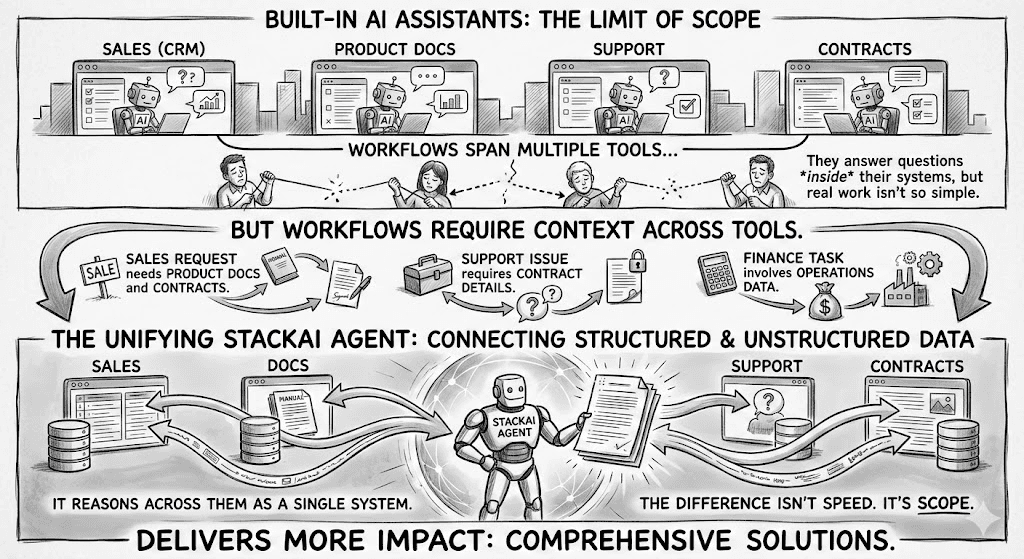
The difference isn’t speed. It’s scope.
2. It Executes Workflows, Not Just Actions
Answering questions is useful. Orchestrating work is transformative.
Built-in assistants typically act inside their own platform: update a record, generate a summary, create an item. But real tasks often span systems.
For example:
Create the customer record in the CRM
Notify the Customer Success team
Generate a project workspace
Send a welcome email to the customer
Log revenue in finance tracking
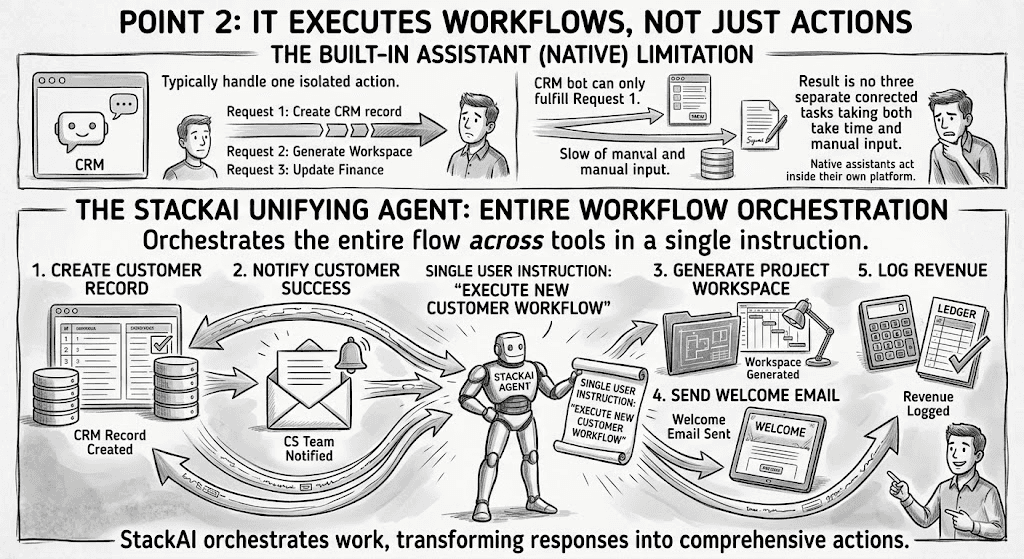
Native assistants typically handle one step. StackAI orchestrates the entire flow.
It doesn’t just respond, but acts across tools in a single instruction.
3. It’s Built for Enterprise Governance
Cross-platform AI only works at scale if control is built in from day one.
Native assistants rely on the permissions of their own platform. StackAI adds a governance layer across systems: granular role-based access, workspace and project isolation, SSO and authentication controls, and full audit logs with version history.
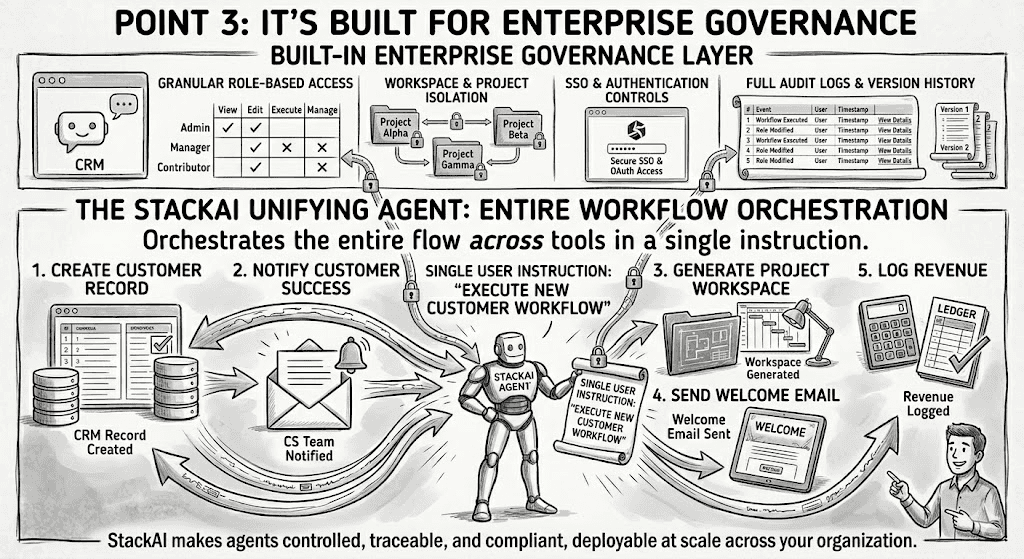
That means agents aren’t just powerful, they’re controlled, traceable, and compliant.
In large organizations, that distinction isn’t optional. It’s what makes AI deployable at scale.
When Native Assistants Make Sense
Built-in AI assistants are improving quickly. They're useful, especially when work happens entirely inside one system. Some departments may live largely within a single tool, and for them, the native assistant delivers real value. But organization-wide transformation is a different problem, and that's where a single platform's boundaries become the ceiling.
But most organizations don’t operate that way.
Workflows cross departments. Data lives in multiple tools. Tasks require context that no single platform owns.
The difference between native assistants and StackAI isn’t about better answers. It’s about broader reach and deeper execution.
Native assistants optimize within their boundaries.
StackAI removes those boundaries.
Want to learn more? Get an AI strategy session with our team here.

Marta Llopis
AI Strategist at StackAI